How Dough Hydration Transforms Your Pizza
Posted by ilFornino New York on 19th Aug 2026
The ilFornino Guide to Mastering Artisan Pizza Dough
Great pizza starts with great dough. At ilFornino, we believe that understanding your dough is one of the best ways to become a better pizza maker.
Flour, water, yeast, salt, and time are simple ingredients, but the ratio of water to flour, called dough hydration, can make a big difference in your pizza.
Hydration influences how your dough feels, stretches, rises, bakes, browns, and develops its final texture in a hot .
If you want a crisp, sturdy crust, use a lower hydration dough. For a chewy center and lighter crumb, try medium hydration. For a light, airy crust with big pockets and strong oven spring, go for higher hydration.
There isn’t one perfect hydration percentage. The best choice depends on your pizza style, flour, fermentation, baking temperature, and how comfortable you are handling dough.
Once you understand hydration, you can start fine-tuning your dough to create the pizza you love.
What Is Dough Hydration?
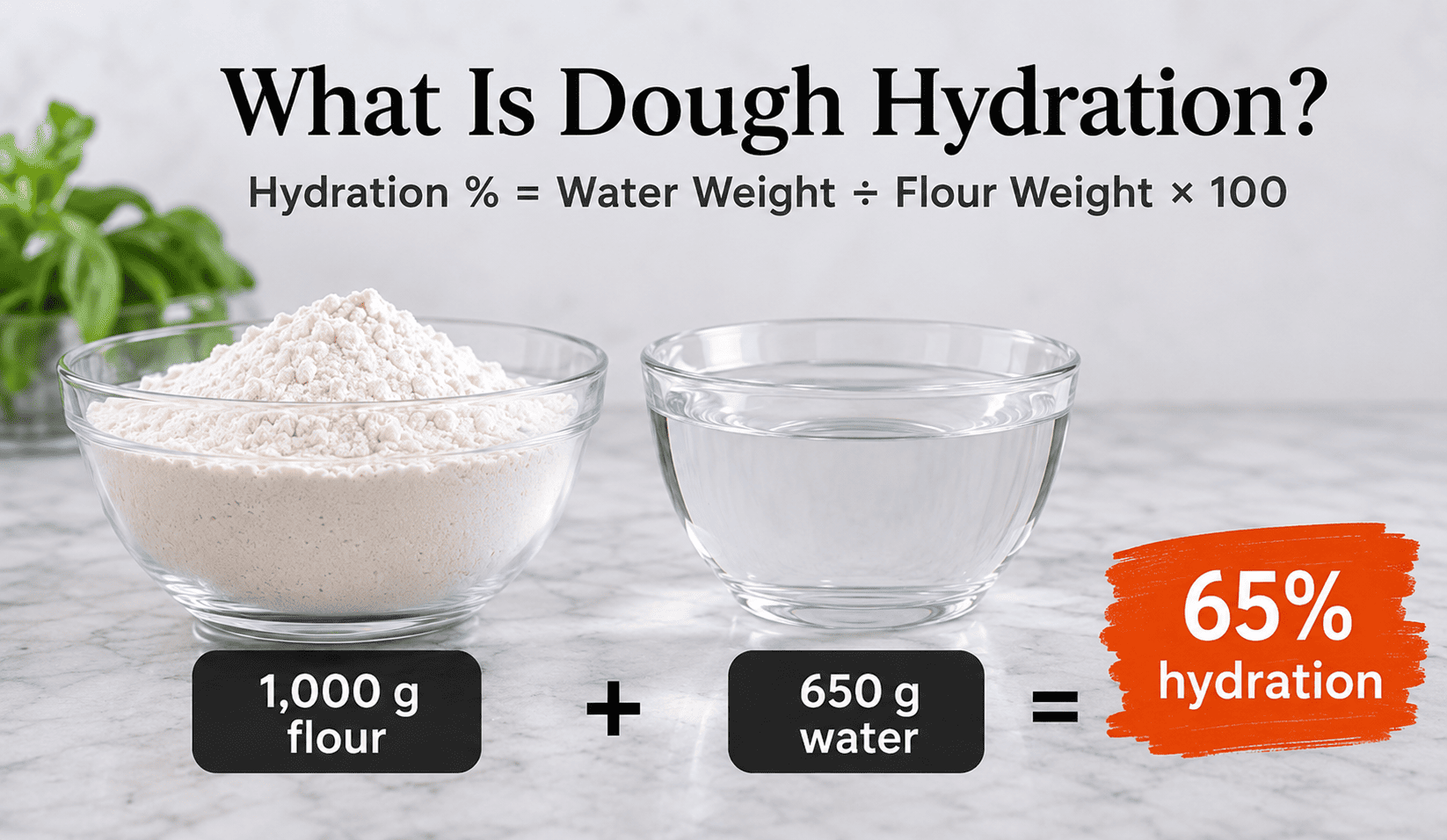
Dough hydration is the percentage of water with respect to the weight of flour in a pizza dough recipe.
The calculation is simple:
Hydration % = Water Weight ÷ Flour Weight × 100
For example:
- 1,000 g flour + 600 g water = 60% hydration
- 1,000 g flour + 650 g water = 65% hydration
- 1,000 g flour + 700 g water = 70% hydration
Working with 500 g of flour:
- 60% hydration = 300 g water
- 65% hydration = 325 g water
- 70% hydration = 350 g water
- 75% hydration = 375 g water
Even a 5% difference can change how your dough feels, ferments, stretches, and bakes.
This is why hydration is such an important factor to understand when making artisan pizza.
Low-Hydration Pizza Dough: More Structure and Crispness
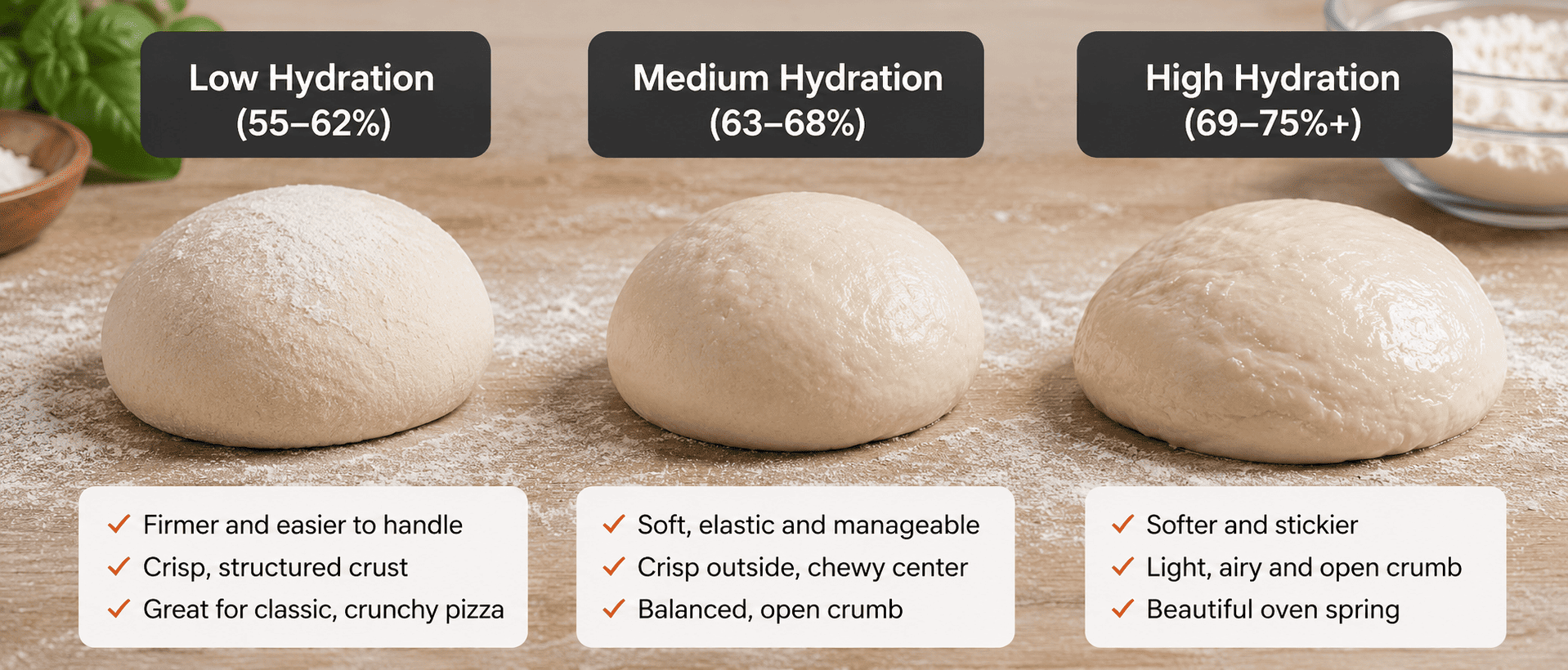
A lower-hydration pizza dough typically falls in the 55–62% range.
With less water, the dough usually feels firmer and is easier to handle. It holds its shape well and is often easier for beginners to stretch and shape.
Low-hydration dough typically produces:
- A firm, structured crust
- A crispier bite
- Easier handling and shaping
- Good support for heavier toppings
- A more compact crumb
- Excellent browning in a hot pizza oven
This style can be a great choice when you want a crisp, sturdy pizza crust that can stand up to generous toppings.
The downside is that lower-hydration dough usually doesn’t create the large, uneven air pockets you see in wetter artisan doughs.
Medium-Hydration Pizza Dough: The Sweet Spot
For many home pizza makers, 63–68% hydration gives a great balance between easy handling and good texture.
As you add more water, the dough gets softer and stretches more easily, but it’s still pretty easy to work with.
A medium-hydration dough can produce:
- A crisp exterior
- A chewy center
- Good oven spring
- A lighter, more open crumb
- Enough strength to support toppings
- A satisfying balance between crispness and chew
This range is a good place to start if you’re trying artisan pizza dough for the first time.
When you bake a well-fermented medium-hydration dough at high heat in an ilFornino wood-fired oven, you can get a nicely browned crust with a light, chewy inside.
High-Hydration Pizza Dough: Light, Airy and Open
Once you reach approximately 69–75% hydration and beyond, dough becomes noticeably wetter and more challenging to handle.
It might feel sticky or loose at first, especially if you’re used to working with firmer dough.
But with the right flour, fermentation, and technique, that additional water can help create an exceptionally light and airy pizza crust.
High-hydration dough can produce:
- Larger air pockets
- A lighter, more open crumb
- A soft and tender interior
- Greater oven spring
- A crisp exterior with a moist interior
- A beautifully irregular artisan crust
This is one reason high-hydration doughs are popular for contemporary artisan pizzas.
However, adding more water doesn’t always make better pizza.
Your flour needs to be strong enough to absorb and hold the extra water. If not, your dough can turn out weak, sticky, and hard to shape.
For high-hydration recipes, it’s usually better to use strong bread flour or high-protein pizza flour.
Hydration Isn’t the Only Factor
It’s easy to think:
Higher hydration = better pizza.
But pizza dough doesn’t work that way.
Two doughs can have the same hydration percentage and still behave very differently.
That’s because hydration is just one part of the process.
1. Flour
Flour strength and protein content affect how much water your dough can absorb and how well it can hold its structure.
A strong flour can handle 70% hydration easily, but a weaker flour might be hard to work with at that level.
2. Fermentation
Fermentation gives the dough time to develop flavor, gluten structure, and gas.
Longer fermentation can significantly change how the dough handles, even when the hydration percentage stays the same.
3. Mixing
Mixing your dough well helps build gluten, which gives it the strength to hold water and fermentation gases.
4. Dough Temperature
Temperature influences fermentation speed.
Keeping your dough at a steady temperature helps you get more consistent results every time you bake.
5. Baking Temperature
This is where an ilFornino wood-fired pizza oven really stands out.
High baking temperatures quickly change the dough, giving you big oven spring, blistering, browning, and the signature char that makes wood-fired pizza unique.
6. Toppings
Don’t forget what’s going on top.
If you use a high-hydration dough with too much sauce, fresh vegetables, or other wet toppings, it might not bake well.
Match your sauce, cheese, and toppings to the type of dough you’re using.
What Happens to High-Hydration Dough in a Pizza Oven?
The real transformation happens when your dough goes into the oven.
As the pizza heats, water in the dough turns into steam. That steam contributes to expansion, while fermentation gases and the gluten network help determine how far the dough can expand.
With a well-developed high-hydration dough, you can get impressive oven spring.
At the same time, the dough’s surface dries out, browns, and turns crisp.
This process creates one of the best features of artisan pizza:
A crisp, beautifully blistered exterior with a soft, moist and airy interior.
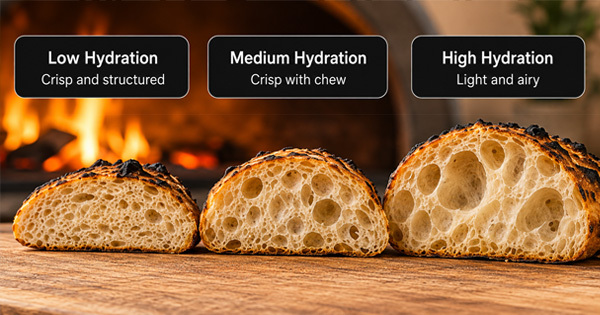
Lower-hydration dough has less water for expansion, so it usually makes a denser, more structured crust.
How Hydration Changes Dough Handling
One of the biggest differences you’ll notice isn’t in the finished pizza, but in how the dough feels in your hands.
A 60% hydration dough may feel:
- Firm
- Smooth
- Strong
- Easy to shape
A 70% hydration dough may feel:
- Soft
- Elastic
- Stretchy
- Slightly sticky
At 75% hydration or higher, the dough can feel very wet and hard to control at first.
Don’t immediately reach for more flour.
Instead, techniques such as resting, stretching and folding, proper gluten development, and gentle shaping can help strengthen the dough without changing your carefully calculated hydration.
Tips for handling high-hydration dough
- Give the dough enough time to rest.
- Use stretch-and-fold techniques when appropriate.
- Develop sufficient gluten strength during mixing and fermentation.
- Handle the dough gently.
- Use lightly floured or lightly oiled surfaces.
- Don’t add too much flour just because the dough feels sticky.
- Give the dough time to develop strength.
You don’t need to get rid of all the stickiness.
The goal is to develop enough gluten strength to hold the water while preserving the open structure you’re trying to create.
Which Pizza Dough Hydration Should You Choose?
Rather than picking a hydration level just by the numbers, think about the kind of pizza you want to make.
|
Hydration |
Dough Character |
Possible Pizza Result |
|
55–60% |
Firm and easy to handle |
Crisp and structured |
|
61–65% |
Moderately soft |
Crisp with good chew |
|
66–70% |
Soft and elastic |
Light, chewy and airy |
|
71–75% |
Wet and extensible |
Very airy, open and tender |
|
75%+ |
Very wet and demanding |
Extremely open, technique-dependent |
These ranges are starting points, not strict rules.
Your flour, fermentation time, dough temperature, shaping technique, and oven temperature will all influence the final result.
How to Choose Hydration for Your Pizza Style
Think about the texture you want on your first bite.
Want a crisp, classic crust?
Start around 55–62% hydration.
Want a balance of crispness and chew?
Try approximately 63–68% hydration.
Want a lighter, more open artisan crust?
Experiment around 69–75% hydration.
Want an extremely open crumb?
Hydration above 75% can produce impressive results, but it requires stronger flour and more advanced dough-handling skills.
Don’t forget, your oven matters too.
A high-performance wood-fired pizza oven like an ilFornino gives you the intense heat needed to quickly bake and expand your dough, creating a beautifully blistered crust.
The ilFornino Approach: Experiment and Make It Your Own
One of the best parts of making pizza is finding out what works for you.
Try making the same dough recipe at 62%, 65%, and 70% hydration.
Pay attention to:
- How the dough feels after mixing
- How easily it stretches
- How much flour you need during shaping
- How quickly it browns
- How much the crust expands
- The size of the air pockets
- The texture of the center
- How crisp the crust remains after baking
You’ll quickly discover that even a small water change can transform the personality of your pizza.
Take notes as you experiment. Over time, you’ll find your favorite hydration level for your flour, fermentation, toppings, and ilFornino oven.
The Takeaway: Hydration Helps Shape Your Pizza
Dough hydration is a key tool for controlling your pizza crust’s texture.
Lower hydration generally gives you structure and crispness.
Medium hydration provides a balance of crispness, chew, and airiness.
Higher hydration can deliver softness, oven spring, and a beautifully open crumb.
But the best pizza isn’t necessarily the pizza with the highest hydration.
The real skill is learning how to balance these factors:
Hydration + Flour + Fermentation + Technique + Oven Temperature
Once you understand this balance, changing a few grams of water isn’t just a recipe tweak it’s part of the art of making artisan pizza.
When you combine this knowledge with the intense heat of an ilFornino wood-fired oven, you have everything you need to keep experimenting, improving, and making your own signature pizza.
Fire up your oven. Adjust your hydration. Make it your own.
Frequently Asked Questions About Pizza Dough Hydration
What is the best hydration for pizza dough?
There is no universal best hydration. For many home pizza makers, 63–68% hydration is a versatile starting range. Lower hydration produces a firmer, crispier crust, while higher hydration can create a lighter and more open crumb.
Is 70% hydration good for pizza?
Yes. A 70% hydration pizza dough can produce a light, airy and chewy crust with excellent oven spring. However, it requires flour with sufficient strength and can be more challenging to shape than a lower-hydration dough.
Does higher hydration make pizza dough better?
Not necessarily. Higher hydration can produce a more open, airy crust, but it also makes the dough harder to handle. The best hydration depends on your flour, pizza style, fermentation, technique, and oven temperature.
What flour is best for high-hydration pizza dough?
A strong bread flour or high-protein pizza flour is generally better suited to high-hydration dough because it can absorb and retain more water while developing enough gluten strength to maintain structure.
Why is my high-hydration pizza dough so sticky?
Sticky dough can be caused by high hydration, weak flour, insufficient gluten development, fermentation, or dough temperature. Instead of adding more flour right away, let the dough rest longer and use stretch-and-fold techniques to build strength.
Does hydration affect pizza oven performance?
Yes. Hydration affects how dough expands, browns, and retains moisture during baking. A very hot wood-fired pizza oven can rapidly transform high-hydration dough, producing significant oven spring and a crisp, blistered exterior.
Ready to Experiment?
The best pizza makers never stop experimenting.
Try a different hydration percentage in your next dough, fire up your ilFornino oven, and see how a little more or a little less water changes your crust.
Find Your Perfect Dough Hydration
Not sure how much flour, water, yeast, and salt you need? Let our Pizza Calculator do the math for you.
Simply choose your pizza style, number of pizzas, and preferred dough hydration and get a customized dough recipe ready for your next bake.
Set your hydration. Build your dough. Fire up your ilFornino.
Featured Products